Independent field note
Apples, a teaching farm and local food around Val-Couesnon
Local food becomes more meaningful when tradition and present-day farming are kept distinct: learn about pommé, then check what growers actually offer now.
Find the place
Address and maps
Les Jardins des Coccinelles
This is the farm visit featured in the guide. Confirm that a visit is available directly before travelling.
Separate a food tradition from today’s offer
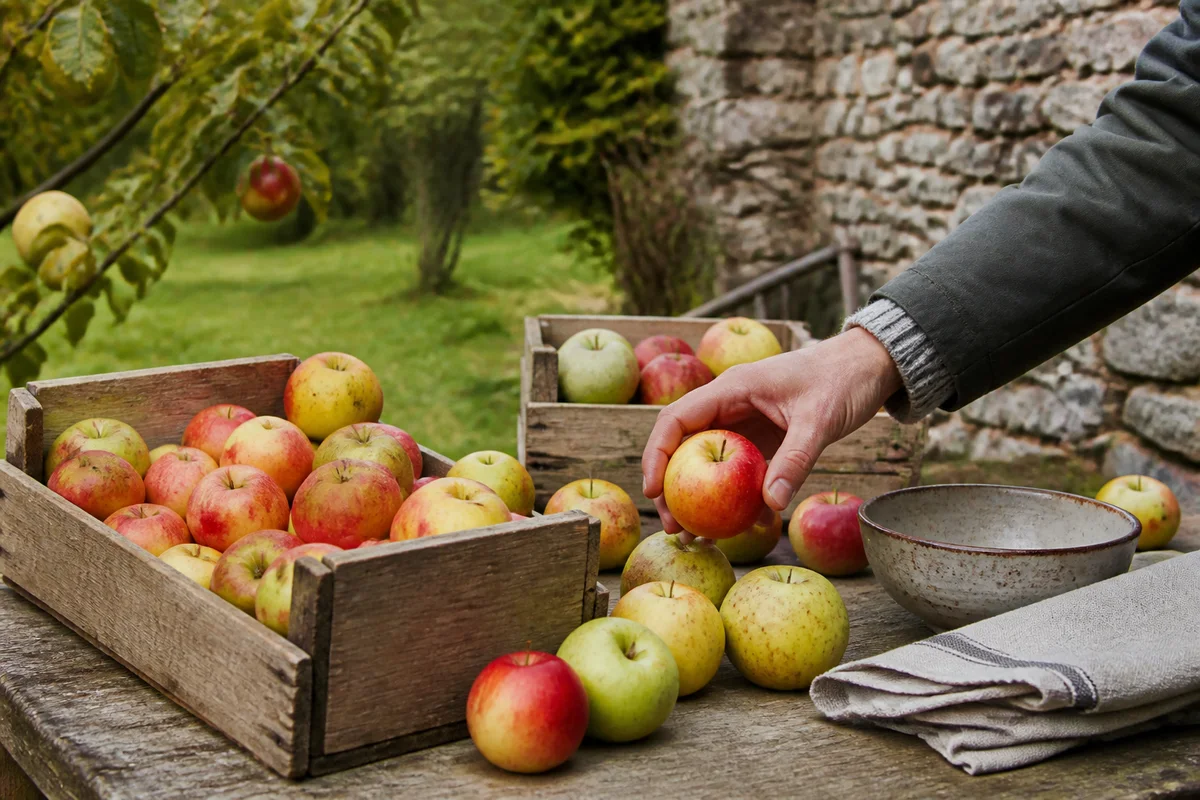
Pommé belongs to the cultural memory of Bazouges-la-Pérouse and Haute-Bretagne. Brittany Tourism describes it as a preparation made from apples and new cider, historically cooked and stirred over a long communal session. That background explains why apples matter here, but it does not prove that pommé is made, sold or celebrated on the day of a visit.
Use the tradition as a starting question: who grows food locally now, how do they work, and where can their current produce be bought? A visit to a working farm or producer shop answers those questions more honestly than searching for a souvenir labelled “traditional.”
Les Jardins des Coccinelles
At Saint-Ouën-la-Rouërie in Val-Couesnon, Les Jardins des Coccinelles describes itself as an organic micro market garden working with living soil and agroforestry. The tourist office lists an educational farm route and a shop bringing together products from local farms.
Start with the tourist office’s educational farm page and the farm’s own website. Visit formats, events, shop opening and booking arrangements can change with the agricultural season. Confirm the current offer directly; do not arrive on private working land because an old post mentions an activity.
Approach it as a working place
Farming continues around visitors. Park only where directed, keep children close, follow hygiene and animal-contact instructions, and never enter a growing area without permission. Weather can affect both the site and what is available to buy.
An educational trail becomes more useful when the group arrives with a few questions: how does soil stay covered, what supports biodiversity, how does the season change the work, and why might a crop not be available? Let the farmer’s current explanation replace assumptions brought from home.
If the shop is open, buy according to present stock rather than a prewritten list. Ask how to store unfamiliar produce and whether packaging can be avoided or returned. A product from another nearby farm can still express the value of a shared local outlet.
Find other producers without using a stale list
The Couesnon Marches de Bretagne Tourist Office publishes a current producer and artisan directory. Use the newest edition on that page to identify farm shops, makers and food businesses, then verify each one directly.
Opening patterns in rural areas may be narrow or based on orders. Contacting a producer is not an inconvenience; it prevents a wasted journey and respects the rhythm of a working farm. Check payment methods, quantities and whether the site actually receives casual visitors.
Build a local-food day
Begin with the Bazouges art and heritage walk, where the town’s heritage material also introduces pommé. Add a farm or shop only after confirming access. Finish with a picnic in an authorised place or a restaurant checked directly for that date.
Keep the route modest. Buying chilled produce early in a hot day creates a storage problem, while arranging several farm calls leaves no time to listen. One meaningful encounter is more useful than a bag of hurried purchases.
Questions to check before leaving
- Is the farm, trail, shop or event open to visitors on the intended date?
- Is advance booking required, and where should visitors park?
- What clothing or footwear suits current ground conditions?
- Are the activity and facilities appropriate for the group’s access needs?
- How should fresh purchases be carried and stored safely?